The power of concealment
Wolf HallThe power of concealment is a recurring principle in Thomas Cromwell’s political life: whoever controls what is disclosed, and what remains unexplained, can shape other people’s fears, loyalties, and choices. It operates in his guarded account of his past, in the king’s discreet use of his counsel, and in the careful staging of legislative and courtly business. Concealment is not simply silence. It is a way of arranging what can be known, by whom, and at what cost.
The Uses of an Unexplained Past
Cromwell sees the danger of becoming an open book when Eustace Chapuys probes his history and repeats allegations about his youth. At times, the questions stir memories of his father, Walter Cromwell, and of the days after Lizzie’s death, when grief and dreams left him uncertain of himself. He feels almost driven to defend his family and childhood, but decides that explanation would weaken him. Instead, he treats the past as something better left unverified: even when there is nothing to hide, refusing to supply a full account preserves the possibility that others will imagine more than he has said.
This guardedness becomes an explicit political insight. Cromwell understands that people respond not only to facts but to the spaces left by their absence; a silence invites them to fill it with their own fears and desires. A half-seen gesture or unreadable expression can therefore exert more influence than a complete explanation. The principle does not require him to invent a false history. Its force lies in limiting access and leaving interpretation to others.
Private Counsel and Public Power
The same discretion governs Cromwell’s proximity to Henry VIII. The king increasingly consults him in private, away from the presence chamber, and does not make the frequency of those meetings conspicuous to the nobles. Chapuys recognizes the political risk: a powerful courtier who is not publicly seen beside the king may still become the object of resentment, gossip, and plots. Cromwell’s influence grows through this partly concealed channel, while those around him must infer how much authority he has acquired.
The king gives the relationship a public face when he appoints Cromwell Keeper of the Jewel House on 14 April 1532. He praises the appointment by invoking Cromwell’s father as an honest blacksmith, a description Cromwell privately finds more flattering than Chapuys’s account of his origins. The office gives him an overview of royal income and expenditure, while the king’s declaration that Cromwell’s advancement depends on him makes their dependence plain. Yet the contrast remains: royal favor is announced, while the daily workings of their political intimacy are kept from view.
Cromwell’s own work also makes information a form of government. At the Tower of London, he checks the paymaster’s accounts, attends to the king’s jewels and plate, and proposes inspecting the weight of the coinage. He prepares a concise memorandum tracing the sources of the king’s yearly revenues and the offices through which they pass. Henry reads it repeatedly, then acknowledges that the late Cardinal Wolsey had held this knowledge in his head. The written account makes financial administration legible to the king; Cromwell’s carefully maintained access to practical information helps convert private knowledge into political capacity.
Legislation as Managed Disclosure
In the early spring of 1532, Cromwell and his allies work through parliamentary papers at night, revising the Commons’ petition against the church courts. The struggle is not conducted by decree alone: bills, amendments, speeches, and parliamentary procedure determine how royal power can be stated and exercised. In a conversation with Katherine of Aragon, she identifies Cromwell as the man who now writes laws and challenges the financial penalty imposed on the clergy under the Praemunire laws, calling it extortion rather than a benevolence. Her charge exposes the contested meanings concealed by official language: the same payment can be presented as service to the Crown or denounced as coercion.
The debate over annates shows how procedure can reveal loyalties while directing political action. Cromwell proposes dividing the Commons physically, with supporters of the bill on one side and opponents on the other. The unusual vote makes members’ positions visible to the king, who watches and learns who is for him and who is against him. In the Lords, the same tactic will not work; Henry must attend in person three times to argue his case. Cromwell’s method thus combines disclosure and concealment: it identifies opponents, while allowing the government to use what it learns to divide them where possible.
The larger argument for royal authority is likewise advanced through selected political and intellectual claims. In 1534, Cromwell rereads Marsiglio of Padua and brings propositions to Henry after Epiphany. Marsiglio’s account places priests under secular authority and denies that the Pope’s power gives princes their legitimacy; it also locates kingship in the will of the people expressed through Parliament. Cromwell reassures Henry that this argument does not license rebellion against a monarch who rules within the law. The exchange makes a radical case for the state’s authority, but frames it in terms designed to reassure the king about the limits of political resistance.
Information, Trust, and the Risks of Disclosure
Cromwell’s private conversation with Anne Boleyn makes information itself a bargaining resource. He reports that Norfolk and Anne’s father, Thomas Boleyn, have been meeting ambassadors from France, Venice, and the Emperor’s household. Anne questions how he can afford such intelligence and notes that people say he has spent a thousand pounds on the cardinal. Cromwell says he expects to recover the money and describes his fee as that of a conveyancer; he also lets her understand that people sometimes tell him things. The disclosure is controlled and suggestive, offering Anne a glimpse of his access without revealing its sources or the full extent of his knowledge.
Yet concealment cannot guarantee trust. Anne repeats her father’s warning that no one can be sure whom Cromwell serves, and concludes that he appears to be working for himself. Cromwell thinks that this makes them alike, but does not say so. His silence preserves the ambiguity between shared political instinct and competing interest. Even a partial confidence can bring a new person into an information network, but it can also leave the motives within that network impossible to settle.
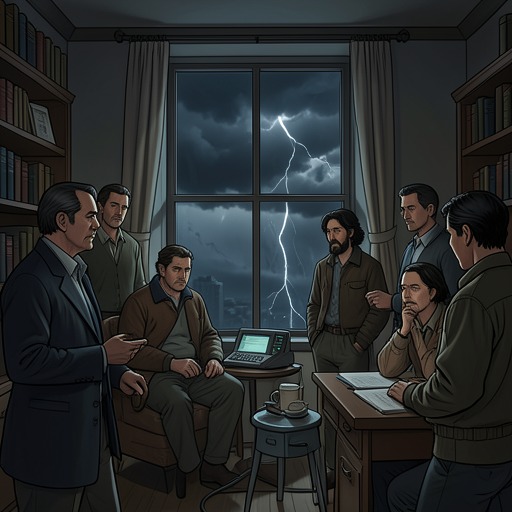
The danger is sharper when a king suspects that his councillor might participate in deception. After a court visit, Cromwell sits before a blank sheet intended as a letter to Thomas Cranmer, but does not write. He recalls Henry’s conversation about a ruby and the king’s belief that he might take part in a backstairs deceit. To defend himself could make him appear guilty; silence, however, does not dissolve suspicion. The scene presents concealment as a double-edged practice: it can protect a person from exposure, but it can also make the absence of an explanation look like proof.
Secrecy as a Political Structure
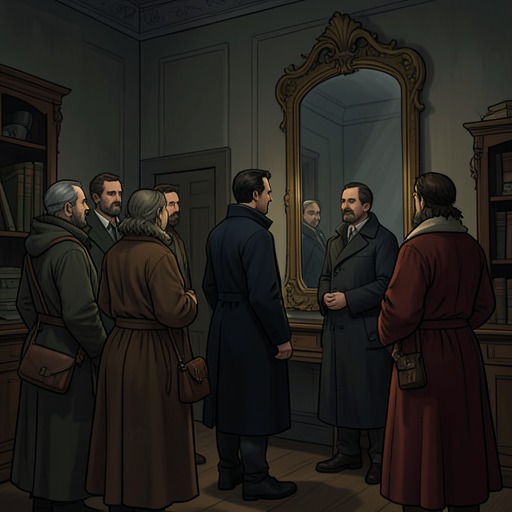
The court itself becomes a compacted world of hidden dealings. Its members travel and live close together, yet Cromwell imagines them as cards in a pack: adjacent, but unable to see. The image joins the chapter’s political mechanism to its title, “Three-Card Trick.” Proximity does not produce transparency; people can share the same confined space while remaining blind to one another’s plans. Cromwell walks away from the garden torches, but his withdrawal does not place him outside the court’s secrets. It gives him a position from which he can observe without making his own intentions fully visible.
That pattern extends from personal memory to statecraft. Cromwell withholds an account of his youth, receives the king’s counsel in private, gathers intelligence at court, and helps create procedures that expose political alignments when exposure serves the Crown. These are not identical acts: some protect him, some increase royal power, and some carry the risk of being misread. Together they show concealment as an active practice rather than a mere absence of speech. It preserves uncertainty for the person who controls the disclosure, but leaves that person vulnerable to suspicion, interpretation, and the changing uses of what others believe they know.